


Discussing care options as a family
08 Jul 2026


Let's be honest. Talking about care with your loved ones isn't exactly anyone's idea of a fun Friday night. It can feel awkward, emotional, and sometimes a little bit scary. And if the person you're talking to feels they don't need any extra help, that can make things even trickier.
But here's the thing: having these conversations before a crisis hits means you get to make choices together, rather than rushing decisions in a hospital corridor when stress is high and options are limited.
At Edyn, we've helped countless families across the UK navigate these conversations. We know they're not always easy, but we also know they're almost always worth having.
Why it's worth starting the conversation early
You might have noticed some changes over the past few months. Perhaps Mum's struggling a bit more with the stairs, or Dad's been forgetting things he never used to. Research shows that 1 in 3 of us notice marked changes in our elderly loved ones over Christmas, when we spend extended time together again and small declines become harder to ignore.
Yet despite noticing these changes, many of us delay having the conversation. Why? Nearly half of people say they put it off because they don't want to upset their loved one, and more than a quarter feel guilty even raising the subject. But here's what we've learned from families we've supported: delaying the conversation doesn't make it easier. When you wait until there's a fall, a hospital admission, or a sudden deterioration, you're forced to make rushed decisions with limited choice and high stress.
Starting early means you can explore options calmly, involve your loved one in the decisions, and find a solution that genuinely works for everyone.
Doing your research

Before you sit down for the conversation, it helps to know what you're talking about. There are different types of care out there, and understanding the options will make you feel more confident, and help you answer questions as they come up.
In the UK, the main options for care at home include:
- Domiciliary care: carers popping in a few times a day to help with specific tasks like washing, dressing, or medication.
- Live-in care: a professional carer lives in the home, providing round-the-clock support while helping your loved one maintain their independence.
- Care homes: full-time residential care outside the home.
All home care providers in England must be regulated by the Care Quality Commission (CQC), who rate services on whether they're safe, effective, caring, responsive, and well-led.
Take some time to research what's available in your area. Look at provider websites, read reviews, and maybe even give a few agencies a call. The more you know, the more you'll be able to guide the conversation, and the less daunting it will feel.
Starting the conversation: a gentle approach
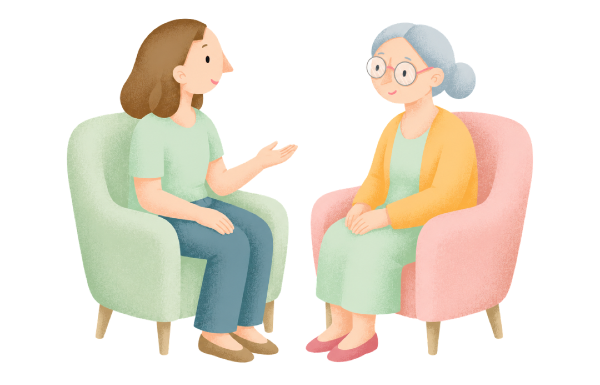
So, you've done your research. Now comes actually starting the conversation.
Here are a few things that can help:
Start with their daily life. Rather than launching straight into "we need to talk about care," begin by chatting about their routine. Ask how they're finding things. Listen for the things they mention struggling with, or even the things they don't enjoy anymore.
Introduce the idea gently. Once you've heard their perspective, you can start introducing the idea of some extra help. Frame it positively: this isn't about taking away their independence, but about making life easier and more enjoyable. It's about giving them the support to keep doing the things they love.
Bring your research. If you've looked into care options, share what you've found. Having information to hand shows you've thought it through and makes the conversation feel more concrete, and less like a passing comment that can be brushed aside.
Be patient. This might not be a one-conversation kind of thing. It's completely normal for these discussions to take place over several weeks or even months. The key is to keep the door open and the conversation going.
What if family members don't see eye to eye?

Maybe one sibling thinks a care home is the right option, while another is convinced live-in care is better. Perhaps someone who lives nearby has seen more of the day-to-day struggles than a relative who lives further away.
Before you start the conversation with the wider family, it can help to think about where others might be coming from. Are they feeling guilty about not being around as much? Are they worried about the cost? Are they in denial about how much things have changed? Understanding their perspective doesn't mean you have to agree with it, but it does help you approach the conversation with empathy rather than frustration.
Involving your loved one in the process

When possible, involve your loved one in every step. Share the websites you've been looking at. Show them brochures or articles you've found helpful. Arrange calls with care agencies so they can ask their own questions.
We know it can feel strange at first: the idea of a stranger coming into the home to provide care. But the right carer doesn't stay a stranger for long. At Edyn, we carefully match our professional carers with clients based on compatibility, so they can build a genuine, positive relationship.
And remember: this is ultimately about empowering your loved one to live life on their own terms: happily, safely, and independently, at home.
How Edyn can help
We know that navigating care options can feel overwhelming. That's why we offer a family care advice service, involving virtual calls where one of our advisors can talk you through live-in care, answer your questions, and help you understand everything from how it works to long-term funding options.
Our Family Care Advisors are here to listen, answer questions, and help you figure out the right next step, with no pressure and no obligation.
Book a care consultation or call us on 020 3970 9900.


Related posts

08 Jul 2026
What Is the Minimum Cover Time for Live-in Care?
Not everyone comes to live-in care looking for a long-term arrangement. Sometimes what you need is support for a few weeks: while a family carer takes a break, perhaps, or while a loved one gets back on their feet after a ...
Read more
08 Jul 2026
When is care needed? How to spot the signs, and what to do next
It's rarely one big moment. More often, it's a string of small ones: a missed hospital appointment, a fridge with nothing much in it, the same cardigan worn three days running. On their own, none of these mean very much. ...
Read more
08 Jul 2026
What can a live-in carer help with?
Most people are surprised by how much a live-in carer can do. The phrase tends to bring to mind the basics: a hand getting dressed, help up the stairs, and those matter. But the real value is often quieter and bigger than ...
Read more